Climate crisis as social crisis

Regionalverband Ruhr (Ruhr Regional Association)
By Bastian Pütter
- Lived experience


The climate crisis is a social crisis. Globally, the impact hits people living in poverty much harder and further exacerbates social inequality. It’s the same for cities in Germany, and specifically for cities in the Ruhr region, such as Bochum and Dortmund.
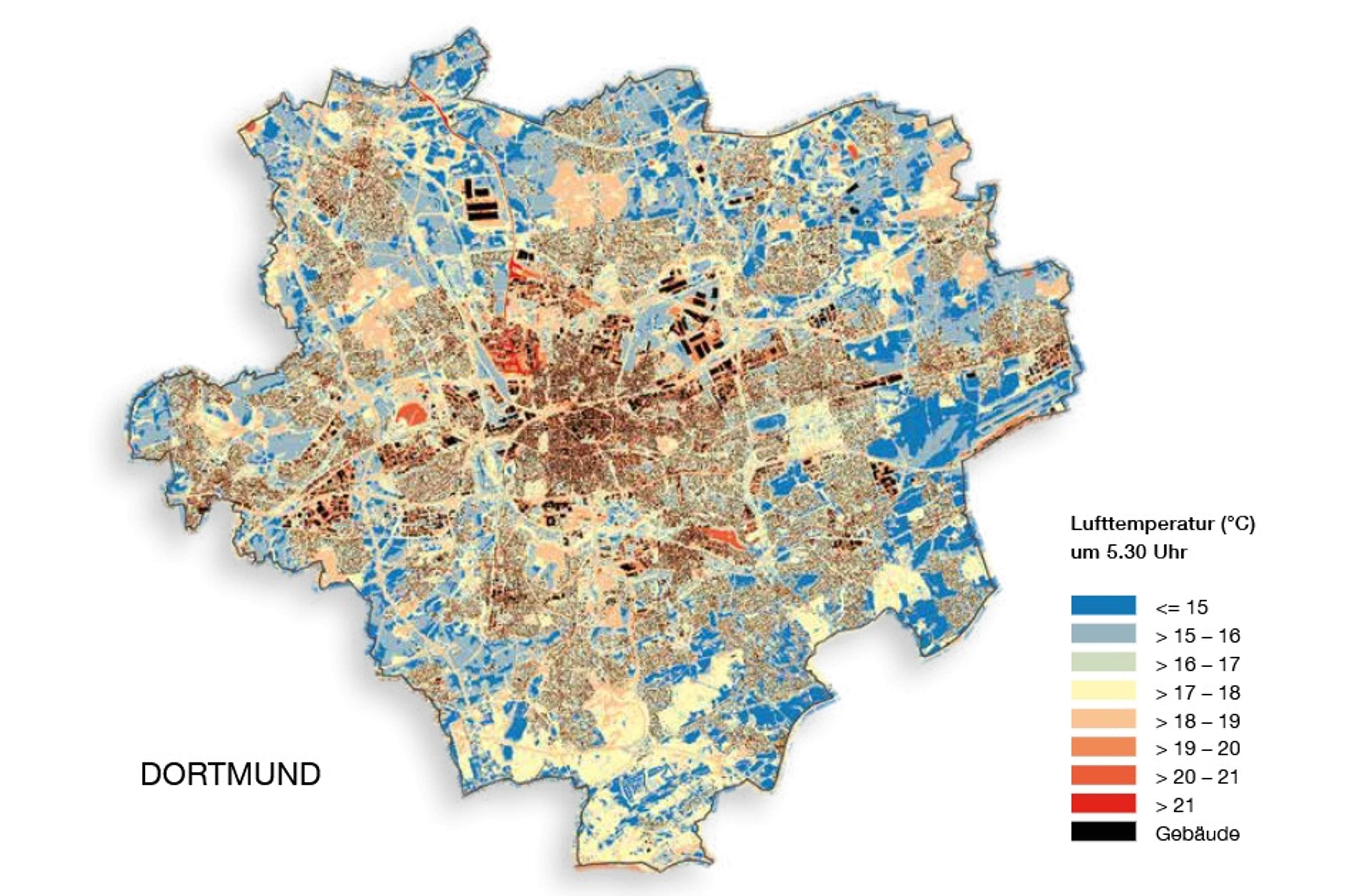
People on a low income are more likely to live in poorly insulated, non-air-conditioned housing in densely populated areas. People who rely on public infrastructure are forced to remain in urban heat islands. The two maps from the Ruhr Regional Association illustrate the uneven cooling across the urban area. On summer nights, the temperature difference between the densely built-up city centre and the rural surroundings can reach up to 10 degrees Celsius.
These so-called tropical nights are not only exhausting but also pose a real health risk. The WHO, the Red Cross and Climate Research Institute describe them as “silent killers”. Heatwaves, which used to be isolated events, are now expected every second to fifth summer; they last longer and result in higher peak temperatures. As a result, the number of days with health warnings for extreme heat has increased by 450 per cent in Western Europe since the 1990s, and the number of heat-related deaths has doubled.
Researchers estimate 6,300 heat-related deaths in Germany in 2024, the warmest year since weather records began, while the Robert Koch Institute estimates around 2,500 deaths for the slightly cooler 2025. This is roughly equivalent to the annual number of all road traffic fatalities in Germany.
Mitigation and adaptation
The answer to the ever-growing threat is both simple and complicated. The massive social and economic consequences of the climate crisis (Germany faces costs of 500 billion euros by 2050 even in a moderate case of temperature rise) can only be limited by a drastic reduction in CO2 emissions.
Germany’s progress so far in the energy, heating and transport transition is mixed. While more than half of its electricity now comes from renewable sources, the heating and transport sectors lag significantly behind. The reactionary response in Germany and the US, for example, is now jeopardising what has been achieved so far.
Nevertheless, climate research has been able to revise downwards the previous worst-case scenario for temperature rise. However, the 1.5-degree target set out in the 2015 Paris Agreement to limit global warming compared to pre-industrial levels is now considered to have been missed. Because the consequences of rising temperatures are already widely visible, given the failure so far to curb this rise, a second area has become increasingly important in recent years.
As an emissions policy alone can no longer mitigate the acute risks posed by heat, drought and flooding, adaptation to its unavoidable consequences, i.e. resilience, preparedness and disaster management, is becoming increasingly important. As early as 2022, the Expert Council on Climate Issues urged the German Parliament in its report to adopt a “paradigm shift” towards a dual strategy of mitigation and adaptation.
Across Europe, politicians are developing heat-health action plans. These set out what measures can be taken before and during periods of dangerously high temperatures. In the long term, however, the so-called urban heat island effect must be reduced in order to protect against more dangerous heatwaves, for example by expanding cooling green and water spaces.
Light and shade
The city of Bochum recently boasted securing one of the top places in the German Environmental Aid’s Heat Check. However, the organisation also notes a loss of 9,500 trees in Bochum since 2018 (Dortmund: 15,000) and an increase in surface sealing.
With its “sponge city” concept, however, Bochum is regarded as one of the pioneers of climate-adapted urban development. Rainwater is no longer quickly channelled into the sewer system, but is instead stored on site, allowed to seep away, evaporate or be discharged at a later time.
Dortmund was one of the first cities in North Rhine-Westphalia to develop a dynamic heat action plan. Through public information and awareness-raising, as well as temporary measures in public spaces and long-term adaptation measures, this plan aims to maintain the usability of the city centre in particular during the climate crisis.
People experiencing homelessness, whose main living areas are often the city centre heat islands, are at least marginally taken into account in the plans. Nevertheless, the strain on support services for those experiencing homelessness is becoming increasingly acute during the hot season.
Although the federal state government is making a total of 250,000 euros available for “summer aid”, which organisations can apply for, sun protection and water bottles only address part of the acute health risks on the streets. Above all, there is a lack of infrastructure and places offering protection from the heat. Day centres are often too small and have hardly any air conditioning.
The City of Dortmund’s “Cool Places” map highlights the social dimension of the crisis. Many of the places listed are neither intended for nor accessible to people experiencing homelessness. Access to public toilets has been privatised under the “Nice Toilet” scheme. The map also highlights shaded benches in the city’s hottest, entirely paved areas and lists the underground stations – but people experiencing homelessness are repeatedly penalised for alleged “fare evasion” simply because they are there.
The city of Bochum has published an eight-page “heat action plan” for those experiencing homelessness, which almost exclusively lists existing homelessness support services. The only additions are that the Provost Church of St. Peter and Paul will stay open longer, pavilions are to be erected outside amenities where possible, and water bottles may be refilled at senior citizens’ centres. That’s not much.
Even though municipalities are actively addressing the need for climate adaptation, they have so far failed to take sufficient account of the fact that the impacts of climate change are distributed in a socially unjust manner. As essential as the efforts to protect all city residents from the consequences of the climate crisis are, they will not succeed without progress in the fight for decarbonisation.