“No one has hope in politics anymore”: homelessness in divided Serbia
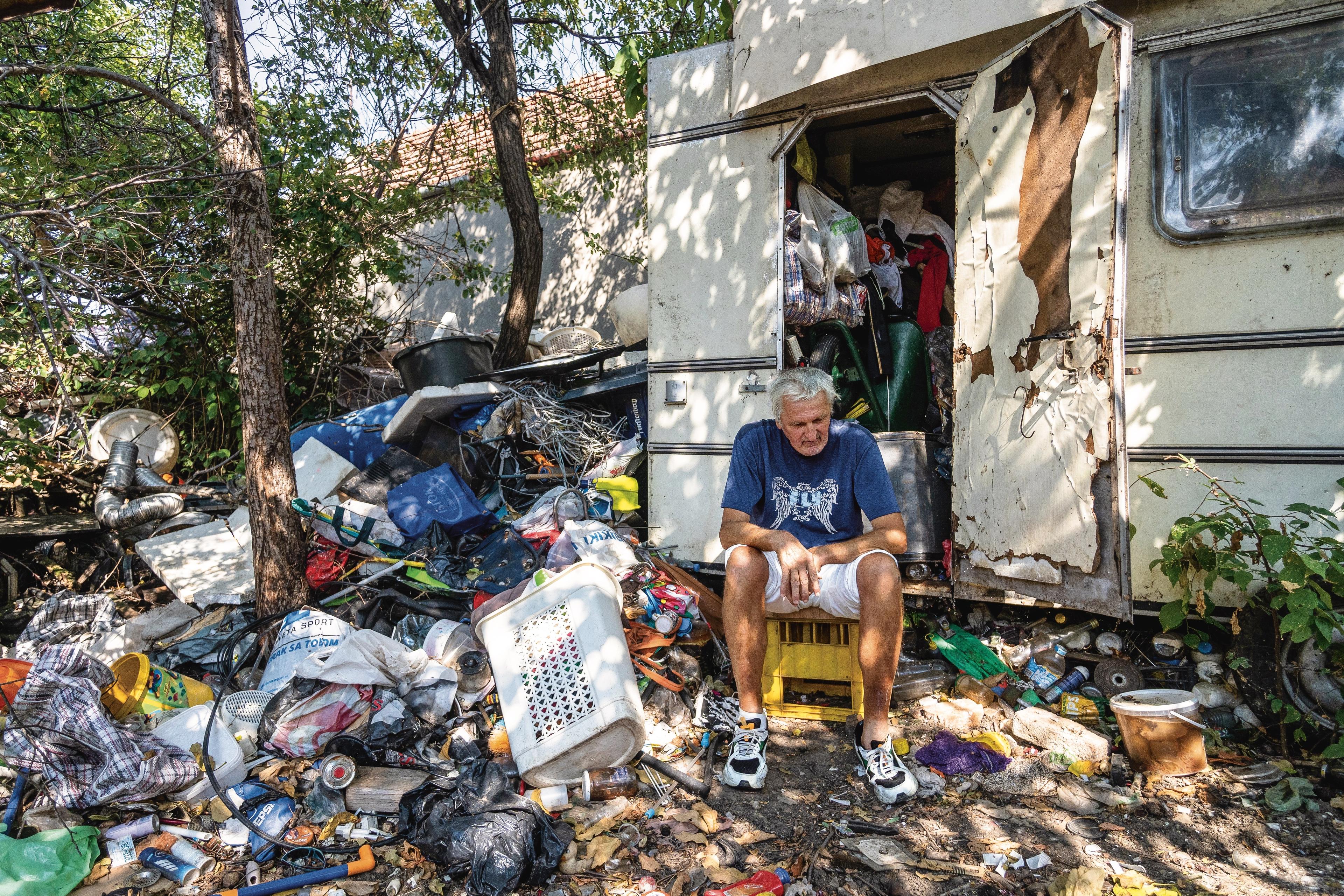

Photo by Marko Risović
By Timo Krstin
- Lived experience

The first thing that catches my eye are the warning notices. In most public buildings in the Serbian city of Zrenjanin, they hang above the sinks: “Warning, do not drink tap water!” If you turn on the tap, a yellow-brown sludge gushes out. Some residents don’t even use the water for showering.
With a population of around 67,000, Zrenjanin is the industrial centre of Banat, part of the Serbian autonomous province of Vojvodina. For over 20 years, the city and surrounding area have had no drinking water. In 2004, an official ban on cooking and drinking water was introduced due to the general pollution in the outdated pipe system and high levels of the carcinogenic toxin arsenic. Since then, despite repeated promises from politicians, nothing has been done.
If you don’t want to put your health at risk, you have to buy water in large blue canisters from the supermarket. People without work and a regular income in particular cannot afford to do this. They are forced to drink from the tap, “and among the poorer people, people experiencing homelessness suffer the most,” says Ana Čkonjević, 38. She runs the emergency shelter at Most, the Social Services Centre in the city of Zrenjanin.
Her office is located in a side street known as a small party mile, with pubs and cafés. However, the actual drop-in centre is in a residential area outside the old town, with architecture still reminiscent of the Austro-Hungarian monarchy. After a few minutes’ drive, she reaches her destination.
While many of the Wilhelminian buildings in the centre stand empty, their doors boarded up and plaster peeling off, the smaller houses on the outskirts of the city seem to be in better condition. An older former residential building serves as an emergency shelter and drop-in centre for people experiencing homelessness. Across two floors are a total of 10 beds with thick feather duvets in four rooms. In one room, a television is on.
To the right of the entrance, a door leads to the former kitchen, which has been converted into an office. In one corner, there is a large blue water dispenser. Čkonjević turns on the tap and water splashes into the glass she holds underneath. “That’s how we make do here,” she says. A canister holds 15 litres and costs the equivalent of around €13.
Although Most is an official institution of the city of Zrenjanin, it was originally a private initiative. About 15 years ago, the city assumed responsibility for it, “but we still work largely independently here,” says Čkonjević. “The city lets us do this, because otherwise there would be no help for people experiencing homelessness. But, in fact, we don’t even have an official license. We’ll only get that when we move into a new building, which has been promised for years but never built.”
Čkonjević turns off the tap and hands the glass of water to an elderly, gaunt gentleman. He has close-cropped hair and a friendly smile. He thanks her and takes a sip. Then he introduces himself as Živan Župunski, but asks to be called Žika. He has agreed to talk about his life on the streets of Zrenjanin.
In the garden, he lights a cigarette and points with it towards the old industrial area. There you can see grain silos, as tall as high-rise buildings, and chimneys on dark grey factory buildings. There used to be between 30 and 40 factories here. Then came the wars and the sell-off in the 1990s. Today, almost all industrial plants from the socialist era stand empty. In the past, entire families worked there, adult children, their parents, sometimes even grandparents, Žika says. “As a young man, I worked with my parents in a rubber factory. Later I was drafted into the army and sent to Bosnia.
In 1992, the Republic of Bosnia and Herzegovina seceded from Yugoslavia following a referendum. The Serb-dominated part demanded to remain in Yugoslavia and have stronger ties to Serbia. A bloody war and ethnic cleansing ensued. In Srebrenica, Bosnian Serb troops committed genocide against the Muslim population. By the time the Dayton peace agreement was signed in 1995, over 100,000 people had been killed. Žika survived. “I was a cook in a barracks,” he says, “and never on the frontline myself.”
No more stability
After returning from the war, he lost his job. Socialist Yugoslavia lay in ruins. Under Slobodan Milošević, who determined politics as president of Serbia and later Yugoslavia, many industrial plants were sold off to shady investors, often with links to organised crime. Factories were cannibalised and shut down. Among other things Žika’s factory had manufactured rubber truncheons for the police: a product that, ironically, there was usually little demand for – until the Milošević regime took increasingly repressive action against its own population.
As early as 1991, there were large demonstrations in Belgrade, which were mainly directed against state propaganda in newspapers and television, and flared up repeatedly until Milošević’s fall in 2000. In addition, there were strikes against the sale and closure of factories, such as in Novi Pazar, with its strong textile industry, and also in Zrenjanin. The police used force against demonstrators and workers. Many who lost their jobs at that time never got back on their feet. At the same time, unemployment destroyed a sense of belonging to the working class that had been developed over decades. Isolation and insularity were the result.
No statistics, little help
Žika returned to Aradac, his home village. He was in his early thirties at the time. “In the countryside, people stick together,” he says. “We support each other wherever we can, and there’s always something to do. I worked illegally on construction sites.” However, because he did not always have enough money for a flat, he sometimes slept in the central park. There, about 10 years ago, he was caught in a sudden cold snap.
Žika interrupts his story, takes off his shoe and shows what is left of his foot after the frostbite. With his stump, he can no longer work on construction sites; he is permanently unemployed and homeless. It is not known how many people in Zrenjanin have suffered similar fates. There are no official statistics.
The Zrenjanin Social Forum (SFZ), an NGO that organises based on trade union principles and advocates for the rights of unemployed people, also has no exact figures. “Nationwide, only 445 homeless people were registered in the 2011 census,” says Tara Milivojević from the SFZ, “while independent organisations estimate that more than 4,000 people are homeless in Belgrade alone.”
In Zrenjanin, Čkonjević knows about 30 affected people who regularly spend the night at Most,” but there are many more,” she says.
Žika later slept beneath a department store in the city centre, a place where many people experiencing homelessness gather. The huge glass building with the inscription “Shopping Family” was intended to bring capitalist consumerism to Zrenjanin at the beginning of the noughties but is largely empty today. In the basement, there are branching passages with dilapidated shop fronts – the so-called underground city. Between 10 and 15 people live there and in an adjoining underground car park. Old mattresses, cardboard boxes and a lot of rubbish, including the common blue water canisters, lie on the floor.
“It’s dirty here and there are often aggressive confrontations because people drink alcohol and take drugs,” says Čkonjević. “But the biggest problem is the fires.” Time and again, people die because they fall asleep by the warming campfire. A regular guest at Most also lost their life there two years ago, and Žika no longer wants to be in such places. However, finding other places to sleep is difficult. In summer, he sometimes finds shelter in the countryside, where an acquaintance keeps bees. Žika looks after the beehives and is allowed to spend the night in a small tool shed in return. In winter, however, it is too cold there. Then he seeks shelter at Most.
“We guarantee a stay of six months,” says Čkonjević. “That's enough to get through the long, damp and cold winters.” After that, the shelter would actually be obliged to show residents the door. However, the managers are happy to be accommodating to people they know well. Žika has already exhausted his six months for this year, but he can still come by to eat and shower.
However, since the shelter is supported by the municipality, only those who have previously registered with the social security office are allowed to stay there: a procedure that takes up to three days and can be a deterrent due to the necessary contact with the police and authorities. Those who nevertheless do register have to decide between social assistance in the form of money or a place to sleep at Most.
Social assistance is not enough to survive on. Single people receive the equivalent of about €96 per month, and families between €138 and €170, depending on the number of children they have. This has to cover all expenditure, and, despite the relatively low cost of living in Vojvodina, is insufficient. If you stay at Most for six months of the year, you have a roof over your head and a warm meal every day, but you have to get through the second half of the year without any help.
Čkonjević and Žika agree that what is missing in Zrenjanin is a more accessible emergency shelter; a room where you can stay for a while with heating and clean drinking water, without having to register or complete other formalities.
In winter, Žika likes to go to the Žarko Zrenjanin library in the city centre. There, he is allowed to stay in the warm for some time, read books and magazines and use the toilet. This is not a minor matter, because there are no public toilets anywhere in the city of Zrenjanin. The library, Čkonjević confirms, is open to people experiencing homelessness, but it cannot replace a real common room for those in need. Although the promised Most new building will supposedly include a day room eventually, no one really believes that this building will ever be built.
Nationwide protests
Public confidence in politics and its institutions is currently at an all-time low. On 1 November 2024, the canopy of the main railway station in Novi Sad collapsed after renovation work, killing 16 people. Since then, students have been organising demonstrations and protest marches across the country, joined by people from all walks of life.
At a march in Belgrade on 15 March, up to 300,000 people from many parts of the country came together. Despite the high number of participants, everything proceeded peacefully. The protestors did not allow themselves to be provoked into violence, neither by the police, who apparently used illegal sonic weapons against demonstrators, nor by a counter-protest group, which – as it later turned out – had been organised by members of the ruling Serbian Progressive Party.
In the meantime, however, the mood threatens to change. Individual groups are breaking the unity demonstrated to date. At the same time, the regime is cracking down ever harder, with the police using tear gas, rubber truncheons and stun grenades and arbitrarily arresting people. Images are circulating of people handcuffed and kneeling on the ground, and ruling party officials are attacking protesters. Many older people feel reminded of the 1990s under Milošević, when his power began to disintegrate and he also brutally attacked his own people.
In Zrenjanin, the protests have so far been largely peaceful. Hundreds gather in the town hall square for the nationwide days of action. However, everyday concerns are rarely addressed. “That has to change,” says Milivojević. “Otherwise, ordinary people will turn away. Then Vučić will have an easy ride.”
“It’s not easy to draw attention to specific issues,” says Čkonjević. “For example, we’ve already had many demonstrations about the dirty water. Often only a handful of people gathered in front of the town hall.”
Žika has also given up hope in politics, and he does not go to demonstrations. Instead, he is pursuing a specific project to improve his own situation somewhat. Together with his sister, who lives permanently in a care home for mentally ill people, he has inherited a small piece of land from his parents in his home village of Aradac. He would like to sell it and use the proceeds to buy a caravan that he could set up near Most. He would then live in the caravan and use Most’s bathroom and kitchen during the summer and move into the shelter for the winter. Čkonjević is supporting him with his plans. She has contacted Žika’s sister and looked for a potential pitch for the caravan.